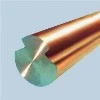
When an alternating current (AC) flows through a conductor, the current density is higher near the surface and lower toward the interior and center, which effectively increases the conductor's resistance-a phenomenon known as the "skin effect." In high-frequency circuits, hollow conductors are often used; since the current flows primarily along the surface, the hollow core has minimal impact on current transmission while helping to reduce overall weight.
In electric generators, a cooling medium is circulated through the interior of these hollow conductors to directly remove heat generated by electrical resistance or the interaction with magnetic field lines. In evaporative-cooled generators, the natural circulation and heat exchange of the cooling medium within the hollow conductors are critical to the generator's overall cooling system. These hollow conductors must not only carry high currents and facilitate efficient heat dissipation but also withstand immense centrifugal forces and the mechanical impact of the cooling fluid. Within a generator, hollow conductors are used to form coils or stator bars that allow for the circulation of a cooling medium, effectively removing heat generated by the conductor's interaction with magnetic field lines.